Health and Wellbeing Plan
This strategic plan outlines our primary goals and priorities for safeguarding, enhancing and promoting public health and wellbeing within Banyule. This plan is integrated in The Banyule Plan to support a holistic and coordinated approach to improving public health and wellbeing.
Vision
All Banyule residents enjoy their highest attainable level of health and wellbeing at every stage of life.
Our aim
To improve health equity by providing responsive, inclusive, prevention-focused, culturally safe services that are discrimination-free.
Key planning approaches
- Cultural determinants of health
- Social determinants of health
- Human rights-based approach to health
- Life stages:
- Healthy start: Pre-natal to 2 years
- Healthy children: 3 to 11 years
- Healthy young people: 12 to 25 years
- Healthy adults: 26 to 59 years
- Healthy ageing: 60+ years
Priorities for improved health and wellbeing
Across the life of this plan, we will focus on five key health and wellbeing priorities to promote health equity.
Priority details
A summary of the details for each priority is provided. For a full list of actions associated with each health and wellbeing priority refer to The Banyule Plan. Complete and detailed explanations about each health and wellbeing priority can be found in Banyule Health and Wellbeing Plan Priorities 2025-2029(PDF, 2MB).

Building Respectful Communities
Building Respectful Communities across Banyule is about creating a culture where everyone is treated with dignity and respect, leading to a safer, more inclusive and supportive community.
What we will do
- First Nations inclusion and cultural safety
- Address family and gender-based violence
- Identify and eliminate discrimination
- Develop and improve social infrastructure
- Address barriers to employment and civic participation.
Regardless of age, identity or ability, being physically active improves overall health and wellbeing, and exercising together fosters social connections and helps build a sense of community.
What we will do
- Make benefits of active living accessible for all bodies
- Diversify the range of free/affordable, inclusive and accessible choices
- Improve wayfinding and promotion to help people connect
- Support people to exercise socially and safely
- Increase tree canopy cover.
By encouraging the establishment of Lifelong Healthy Habits, we can foster a healthier, happier and more sustainable future for all Banyule residents.
What we will do
- Partner with local First Nations groups to improve health outcomes
- Address barriers to health equity
- Foster wellbeing throughout life
- Support a great start to life
- Address modifiable risk factors through health promotion.

Healthy Planet, Healthy People
Integrating natural environments into daily living can lead to a happier, healthier and more connected community and connecting with nature fosters behaviours that protect and preserve the natural environment.
What we will do
- Put Caring for Country principles at the centre
- Strengthen neighbourhood ecosystems to enhance capacity and resilience
- Invite people to connect with and care for our natural environments
- Foster eco-wise practices and further climate action
- Enhance biodiversity, waterways and green open spaces.

Social Connection with Purpose
Social connections foster meaningful interactions between diverse groups and like-minded people, leading to an increased sense of belonging and overall better health outcomes.
What we will do
- Actively support First Nations self-determination
- Support for people to form relationships and express themselves
- Targeted social connection and belonging initiatives
- Intergenerational, intracultural and intercultural connections
- Enhanced vocational and volunteering opportunities.
How we're implementing the Plan
We’re delivering the plan through a collaborative, whole of Council approach that includes:
- Leads and working groups for each priority area
- Annual Health and Wellbeing Implementation Plan
- Ongoing monitoring and reporting, for example an annual Health and Wellbeing Achievements Report
- Partnership roundtable to connect internal and external partners
Background
Across Victoria, all councils must address the health and wellbeing needs of their communities through a Health and Wellbeing Plan. This strategic plan outlines each council’s primary goals and priorities for safeguarding, enhancing and promoting public health and wellbeing within the municipality.
Council integrates the Municipal Public Health and Wellbeing Plan into the Banyule Plan, as this approach supports a more holistic and coordinated approach to improving public health and wellbeing. This ensures that public health and wellbeing outcomes are prioritised across all Council activities.
Our Health and Wellbeing Plan was developed in alignment with the Victorian Public Health and Wellbeing Plan 2023–2027. It was informed by community insights, local data, and evidence-based practice, and takes an intersectional approach to reducing health inequities.
For more information on the development of our Health and Wellbeing Plan, visit Banyule Futures.
Foundations of Health and Wellbeing
Council plays an important role in laying the foundations for good community health and wellbeing.
There are a broad range of activities Council manages to support community health and wellbeing. Through these combined efforts, Councils fosters environments where community members can thrive physically, mentally, spiritually and socially.
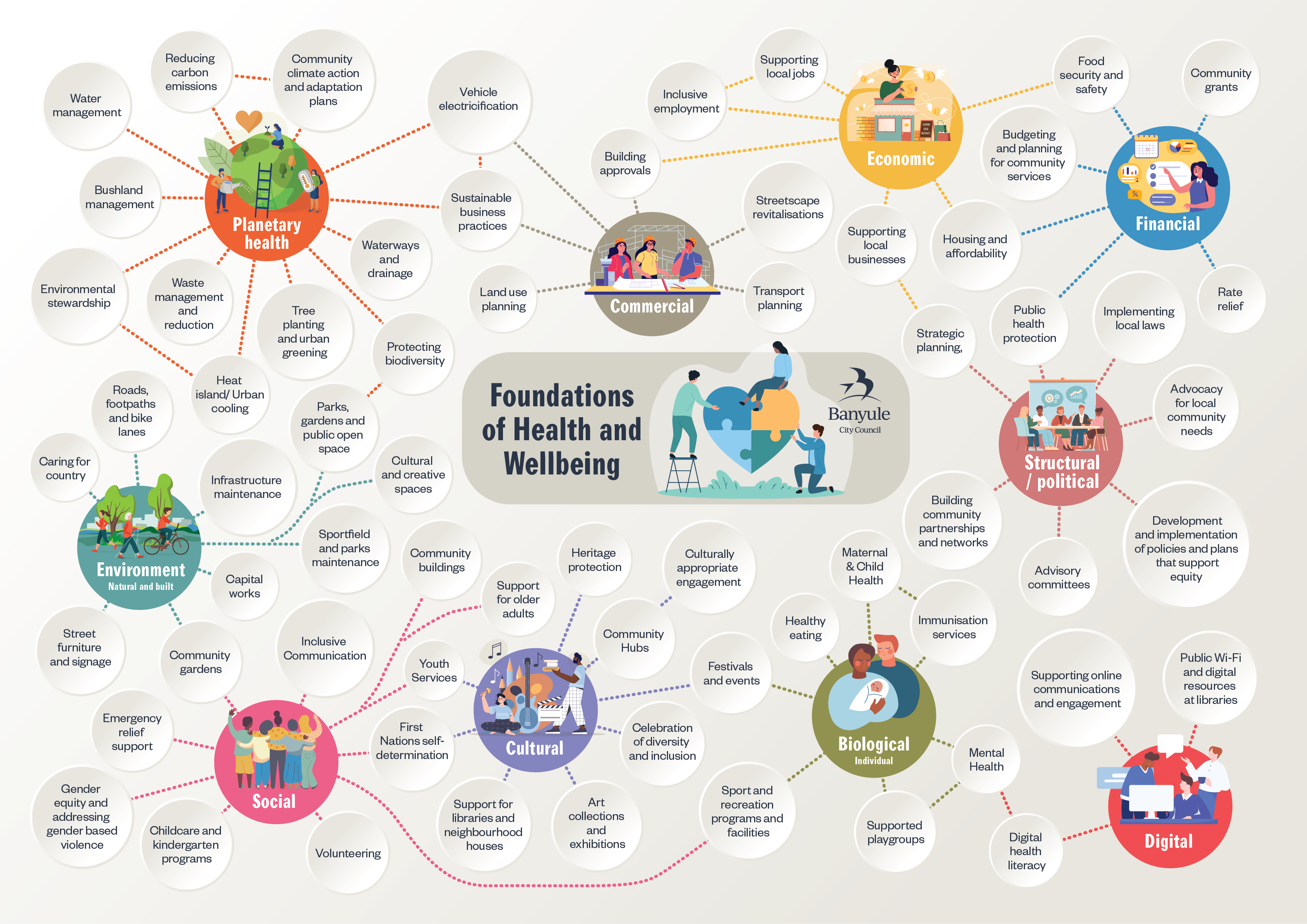
Mapping the foundations of health and wellbeing
The Foundations of Health and Wellbeing map sets out the building blocks that support a healthy, resilient community. Each foundation end point represents a specific area of action or focus. Some end points are connected to one of 10 broader categories - Biological (Individual), Commercial, Cultural, Digital, Economic, Environment (Natural and built), Financial, Planetary health, Social, Structural / political - while others are directly linked to one another, showing how different aspects of community wellbeing are interdependent.
Biological (Individual)
This category includes 7 foundation end points:
Foundations: Festivals and events; Healthy eating; Immunisation services; Maternal & Child Health; Mental Health; Sport and recreation programs and facilities; Supported playgroups.
Commercial
This category includes 6 foundation end points:
Foundations: Building approvals; Land use planning; Streetscape revitalisations; Sustainable business practices; Transport planning; Vehicle electrification.
Cultural
This category includes 9 foundation end points:
Foundations: Art collections and exhibitions; Celebration of diversity and inclusion; Community Hubs; Culturally appropriate engagement; Festivals and events; First Nations self determination; Heritage protection; Support for libraries and neighbourhood houses; Youth Services.
Digital
This category includes 3 foundation end points:
Foundations: Digital health literacy; Public Wi-Fi and digital resources at libraries; Supporting online communications and engagement.
Economic
This category includes 6 foundation end points:
Foundations: Building approvals; Food security and safety; Housing and affordability; Inclusive employment; Supporting local businesses; Supporting local jobs.
Environment (Natural and built)
This category includes 9 foundation end points:
Foundations: Capital works; Caring for country; Community gardens; Cultural and creative spaces; Infrastructure maintenance; Parks, gardens and public open space; Roads, footpaths and bike lanes; Sportfield and parks maintenance; Street furniture and signage.
Financial
This category includes 6 foundation end points:
Foundations: Budgeting and planning for community services; Community grants; Food security and safety; Housing and affordability; Public health protection; Rate relief.
Planetary health
This category includes 12 foundation end points:
Foundations: Bushland management; Community climate action and adaptation plans; Environmental stewardship; Heat island/ Urban cooling; Protecting biodiversity; Reducing carbon emissions; Sustainable business practices; Tree planting and urban greening; Vehicle electrification; Waste management and reduction; Water management; Waterways and drainage.
Social
This category includes 11 foundation end points:
Foundations: Childcare and kindergarten programs; Community buildings; Community gardens; Emergency relief support; First Nations self determination; Gender equity and addressing gender-based violence; Inclusive Communication; Sport and recreation programs and facilities; Support for older adults; Volunteering; Youth Services.
Structural / political
This category includes 7 foundation end points
Foundations: Advisory committees; Advocacy for local community needs; Building community partnerships and networks; Development and implementation of policies and plans that support equity; Implementing local laws; Public health protection; Strategic planning.
Supporting information and downloads
Banyule Health and Wellbeing Plan Priorities 2025-2029(PDF, 2MB)
Alternative formats
Easy Read Banyule Health and Wellbeing Plan(PDF, 4MB)
Easy Read text only Banyule Health and Wellbeing Plan(DOCX, 39KB)
Banyule Health and Wellbeing Plan on a page(PNG, 472KB)
Large print Banyule Health and Wellbeing Plan detailed report(DOCX, 6MB)
Who can help you
Contact our Community Impact team if you have questions or would like to get involved by emailing impact@banyule.vic.gov.au